
Sign-on runs through your own directory
Accounts live in your identity provider, and sessions are enforced at the server
Your OpenID Connect or LDAP provider governs accounts, passwords, and multi-factor policy. There is no parallel directory of users to provision or keep in step.
Sessions lock after inactivity and on demand, and signing out invalidates the session at the server.
Every API operation checks the caller's permission
A least-privilege role table ships as standard
The role table caps what every session can do. In production, even an administrator cannot delete a compliance record.
Your administrators author one declarative policy file that sets what each role may do
The policies you bring are a file your administrators author. Each role carries a tier of permissions, and the file refines that grant action by action, allowing or denying named operations such as approving a recipe or shelving an alarm. It is versioned like any other configuration and read by the control plane at startup.
The record cannot be quietly changed
An admission check rejects any edit, and a signature breaks if its content changes
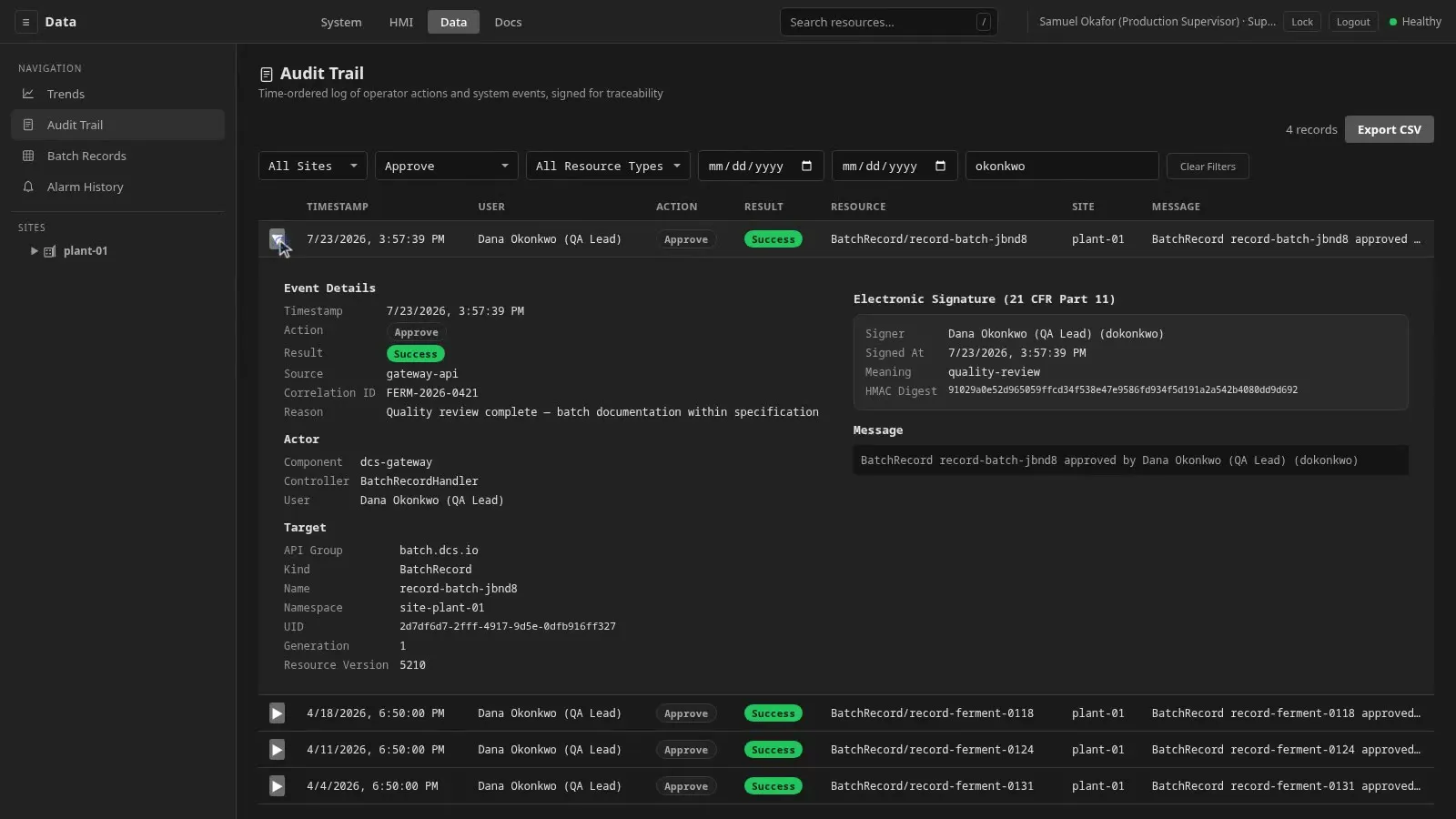
Electronic signatures are bound by a keyed hash to the exact content they approve, so changing that content after the fact invalidates the signature. Review and approval are held to separate people, enforced independently in two places, and the signing keys are versioned so they can be rotated without breaking past signatures.
An isolated network with one door
Every boundary denies all traffic by default, and one HTTPS port is the perimeter's only way in
IEC 62443, the international standard for industrial cybersecurity, asks for zones and conduits. The default-deny segmentation is that model, expressed as native network policy.
Mutual TLS between every component
A built-in certificate authority issues short-lived certificates and renews them automatically
Mutual TLS means both ends of a connection prove their identity to each other before data moves. Telemetry from the plant floor rides the same encrypted transport.
Encryption at rest is a storage-layer control, configured on the cluster you run Cloud-Native DCS on.
A signed and scanned supply chain
The build fails on any high-severity finding, and images ship minimal and non-root
Traceable to IEC 62443
A control-by-control matrix traces each control to IEC 62443-3-3
The matrix lives in the documentation and states each control's status. Cloud-Native DCS substantially implements the controls for Security Level 2, the standard's four-tier rating of protection strength, with elements of Security Level 3.
See the full posture
The regulatory and quality side, from 21 CFR Part 11 to GAMP 5 and validation, lives on the compliance page
Read the traceability matrices in the engineer documentation →