
Compliance
Every action leaves a sealed record
Audit trail, e-signatures, and change control, built into the data model
All three are part of the same model the plant runs on, so the record is written as the action happens. Every version of the product ships them. Role-based access is enforced on production-critical operations. The audit trail and the electronic records satisfy each of the ALCOA+ principles that regulators apply to data integrity.
Regulations
Legally binding for regulated manufacturing
These regulations are answered by controls built into the data model and shipped in every version of the product
21 CFR Part 11: Electronic Records and Electronic Signatures
Audit trail, e-signatures, and change control are built in, immutable once written
How it's answered
21 CFR Part 11: Electronic Records and Electronic Signatures
Audit trail, e-signatures, and change control are built in, immutable once written
How it's answered
The FDA's rule on electronic records and electronic signatures
Once a record is written it cannot be edited or deleted. Every state-changing action carries a timestamp and a user-identity attribution. No controlled change is admitted unless its audit record is written first, so the record can never fall behind the action. Archived records are write-once, cryptographically sealed, and re-verified on a schedule that records its own result.
EU GMP Annex 11: Computerised Systems
Traceability, authorisation, and data integrity from the audit trail, roles, and sealed records
How it's answered
EU GMP Annex 11: Computerised Systems
Traceability, authorisation, and data integrity from the audit trail, roles, and sealed records
How it's answered
The European Medicines Agency's requirements for computerised systems used in GMP manufacturing
The audit trail and attributable user identities give traceability, role-based access gives authorisation, and durable, sealed records give data integrity. Because the audit trail is a queryable part of the live model, the periodic audit-trail review Annex 11 expects runs against the records directly.
21 CFR Part 211: Current Good Manufacturing Practice (cGMP)
Complete batch genealogy, role-based access, and the electronic batch records required for quality release
How it's answered
21 CFR Part 211: Current Good Manufacturing Practice (cGMP)
Complete batch genealogy, role-based access, and the electronic batch records required for quality release
How it's answered
The FDA's cGMP regulation for finished pharmaceuticals
Cloud-Native DCS produces complete batch genealogy, enforces role-based access on production-critical operations, and generates the electronic batch records that quality release depends on.
Industry standards
What your plant's specifications require
Cloud-Native DCS is built on the standards your automation and quality engineers work to
See the security posture, from IEC 62443 to the network and supply-chain controls
ISA-88 / IEC 61512: Batch Control
The ISA-88 batch model is the foundation the rest of the system is built on
How it's answered
ISA-88 / IEC 61512: Batch Control
The ISA-88 batch model is the foundation the rest of the system is built on
How it's answered
The international standard for batch control
Cloud-Native DCS implements the ISA-88 batch model, from the physical and procedural models through master and control recipes to batch execution. The model does not change with the product type, from finished product through active ingredients and intermediates.
IEC 61131-3: Control Programming
Control logic in Structured Text, Function Block Diagram, and Sequential Function Chart, editable as diagram or text
How it's answered
IEC 61131-3: Control Programming
Control logic in Structured Text, Function Block Diagram, and Sequential Function Chart, editable as diagram or text
How it's answered
The standard for programmable-controller languages
The IEC 61131-3 languages are the ones automation engineers use on traditional PLCs and DCSes. A control module's logic is one model with two editable views, and an edit in either view updates the other. Phase templates are authored the same way.
ISA-18.2 / IEC 62682: Alarm Management
Every operator decision on an alarm is audited, with definition, shelving, and suppression part of the model the plant runs on
How it's answered
ISA-18.2 / IEC 62682: Alarm Management
Every operator decision on an alarm is audited, with definition, shelving, and suppression part of the model the plant runs on
How it's answered
The standard for the alarm-management lifecycle
Acknowledging an alarm silences its notification while the condition stays active. Shelving suppresses that notification for a set duration. The alarm itself stays visible, marked as shelved until the window expires. Acknowledgement and shelving are separate operator decisions, and each is written to the audit trail under the name of the person who made it.
Guidance frameworks
What auditors expect to see
Where GAMP 5 validation, FDA Computer Software Assurance, and ALCOA+ data-integrity principles apply, the product writes a sealed audit trail and ships qualifications as commands you re-run
See how the executable qualification suite supplies the GAMP 5 vendor half
ICH Q9(R1) and Q10: Quality Risk Management and Quality Systems
Change control and review workflows integrate with your existing quality system
How it's answered
ICH Q9(R1) and Q10: Quality Risk Management and Quality Systems
Change control and review workflows integrate with your existing quality system
How it's answered
The guidance on quality risk management and the pharmaceutical quality system
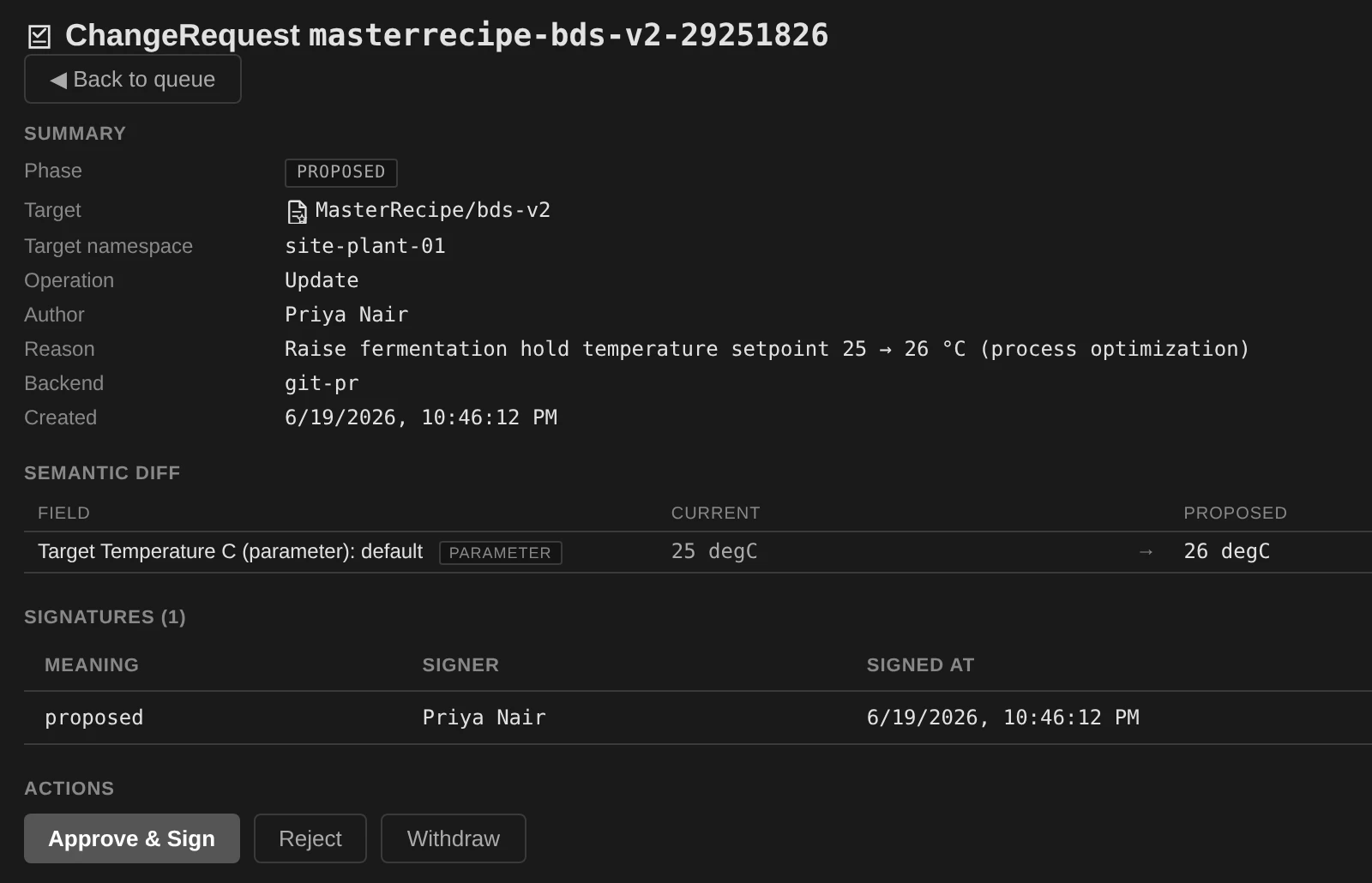
Cloud-Native DCS presents a controlled change as a semantic diff in plant terms, and holds it out of production until it is signed.
Validation is a shared responsibility
GAMP 5 splits validation between vendor and customer, and the qualification suite supplies the vendor half
Cloud-Native DCS ships an executable qualification suite that runs the installation, operational, and performance qualification (IQ, OQ, PQ) against your deployment. The operational qualification threads every batch-state transition to its immutable audit record. The performance qualification computes process capability from your own specification limits and reports a pass or a fail against the FDA-default threshold.
The vendor produces evidence of how the software was built and tested. The customer validates against their own intended use and quality management system (QMS). Cloud-Native DCS supplies the vendor half, with versioned releases, signed artifacts, CI evidence, and that suite. Your QMS decides what "validated" means in your plant, and the suite gives your quality team a repeatable way to prove it.
Recipes, equipment hierarchies, alarm definitions, and phase templates are configuration on a standard, versioned software product. That is the profile GAMP 5 calls a Category 4 configured product, and it keeps the validation effort risk-based and proportionate. The same vendor evidence is the build-and-test record the FDA's Computer Software Assurance approach draws on.